

AI-supported, for municipalities
Strategic foresight (optional: with AI tools): from a vision of the future to measures and indicators.
We have used trend analyses, target pictures and draft visions in municipal strategies since 2022. Since 2025, AI tools have complemented this work. In the project, they are used to develop scenarios and visions of the future. Every result is reviewed before it goes into a document; decisions are made by the administration and its decision-making bodies.
Arrange a first meetingStrategic foresight here means: in the project, the city's previous work is evaluated and the trends and influencing factors (developments that will shape the city up to the strategy's target year) are analysed. This produces scenarios and visions of the future (vivid descriptions of the city in the target year). The shared vision of the future feeds into the mission statement, fields of action, measures with a schedule and indicators. AI comes in as an additional tool. At every step, the consultants and the responsible offices of the administration review the content.
“In urban development, AI-supported analyses, scenarios and digital twins are needed to make planning data-based and participatory.”
From foresight to strategic management.
In the project, the work passes through six stages. Each stage shows which body is responsible for review, agreement, decision or management.
Foresight
- 1
Trends and influencing factors
Screening of previous work, trend analysis, selection of influencing factors.
Review: core team of the administration - 2
Scenarios and visions of the future
Development of several scenarios and of the visions of the future derived from them.
Review: specialist units
Into strategic management
- 3
Shared vision of the future
Merging of the scenarios into one vision of the future for the city.
Agreement: administration and elected representatives - 4
Mission statement and fields of action
Derivation of vision, goals and fields of action from the vision of the future.
Review: management board - 5
Measures with schedule and indicators
Derivation of the measures and of indicators for each measure, placed in a schedule based on the meeting calendar.
Decision: specialist committee, management board, council - 6
Impact measurement and updates
Continued tracking of the indicators in regular operation, responsibility and update cycle.
Management: administration
Sample images: one town square today and in two future scenarios
In a project, selected scenarios are visualised at real places in the city. These three images show the format for a fictional town: the same square today and in two future scenarios, each with an explanatory text and one indicator.
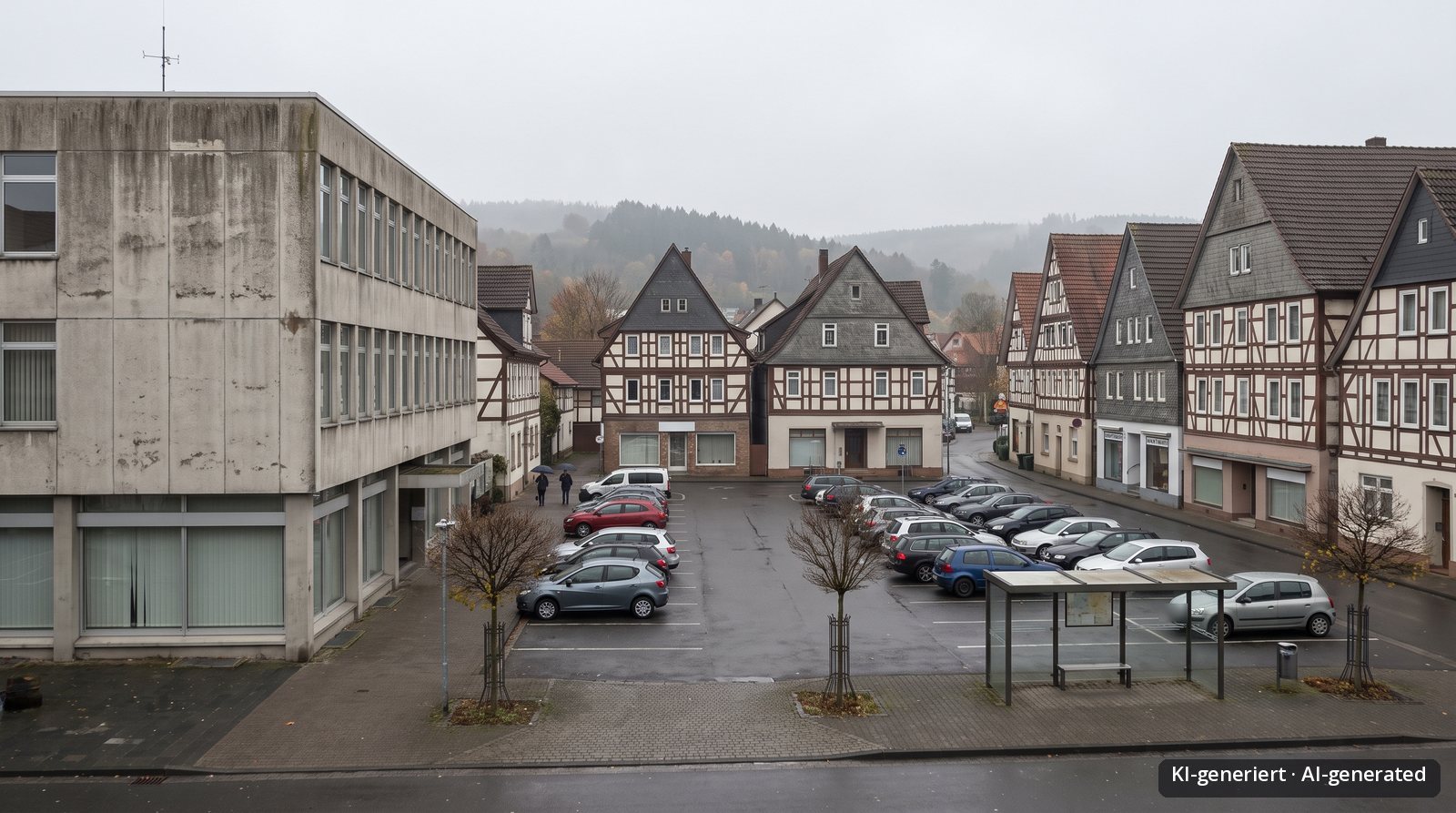
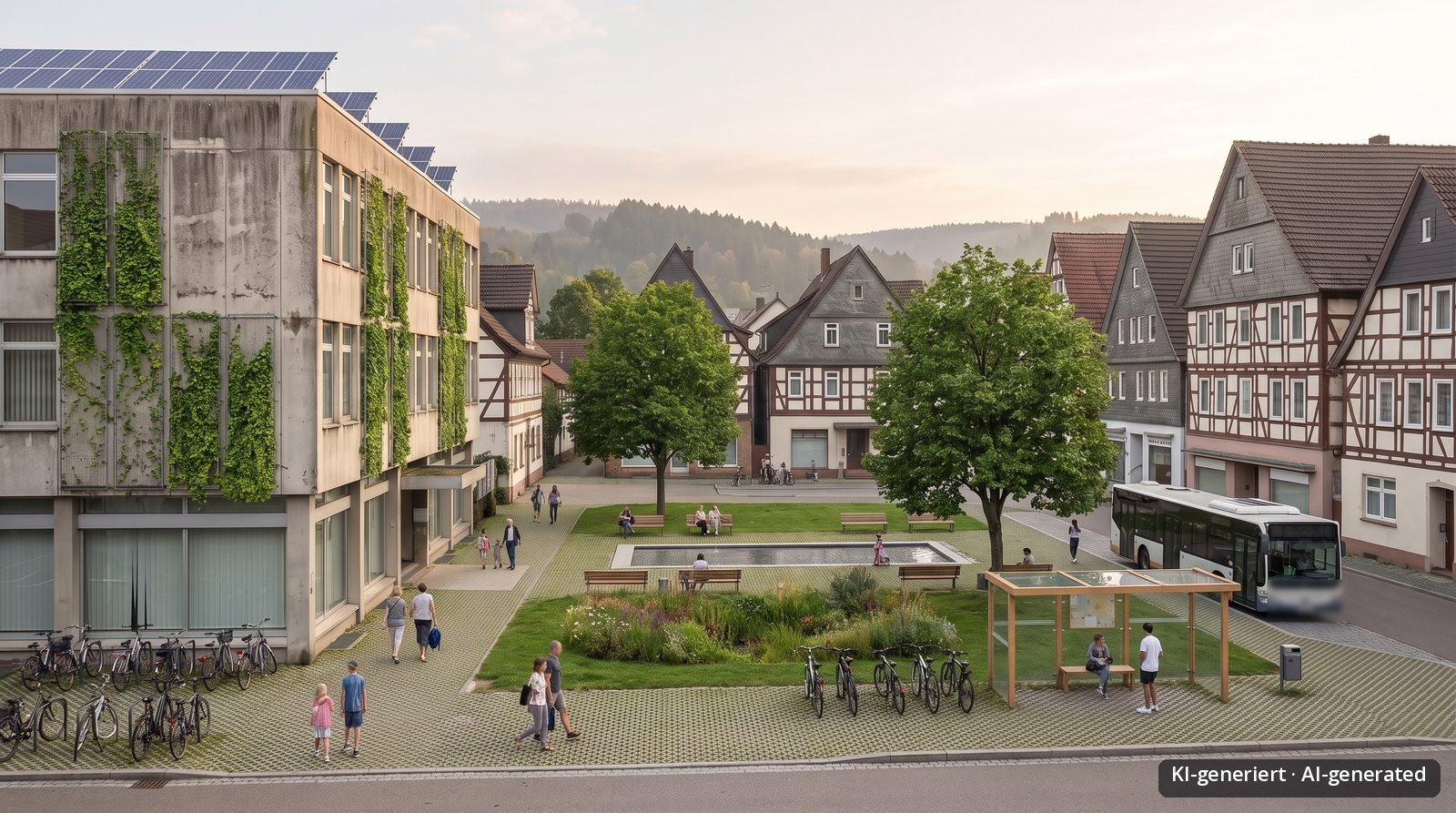
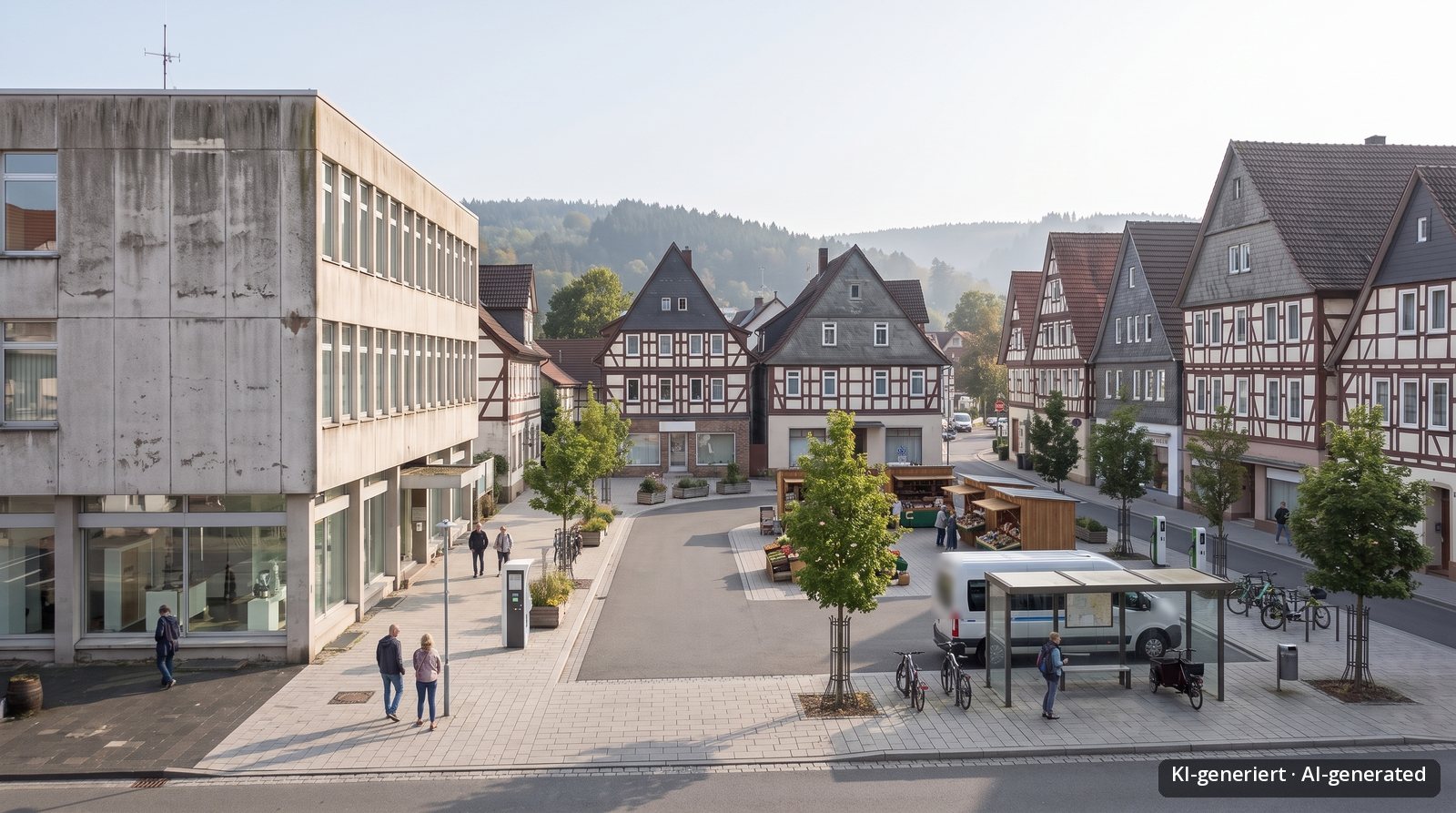
Images of a fictional town created with AI tools, labelled under Article 50 of the EU AI Act. Not a real place and not a planning proposal.
Building blocks from trend analysis to the strategy update.
The city's previous work as the starting point
The foresight builds on the city's previous work: existing strategies, concepts, sectoral plans and the results of earlier public participation. The screening is done in agreement with the administration's core team. Since 2025, AI tools have supported the evaluation of the documents.
Influencing factors and trends
The trend analysis follows Gartner's Hype Cycle (a classification of technology trends by maturity) and assigns trends to the city's fields of action. In the project, the influencing factors are added. The administration's core team selects which of them are relevant for the city.
AI-supported scenarios, checked by calculation in the project
In the project, several future scenarios are developed from the selected influencing factors, with AI support and using the scenario technique (a method for deriving internally consistent developments from influencing factors). Every scenario is checked for consistency by calculation (a pairwise check of whether the assumptions fit together). Every statement is linked to its source.
Scenarios as narratives
In the project, every scenario is written as a coherent narrative, each from the perspective of citizens, the administration and local businesses. The narrative describes what everyday life in the city looks like in that scenario. The specialist units check whether the description is accurate for their area.
Images of the future for real places, created and labelled in the project
In the project, selected scenarios are illustrated at real places in the city, such as a square or a neighbourhood. Every image is labelled as artificially generated in accordance with Article 50 of the EU AI Act. It is expressly not a planning proposal; the explanatory text appears next to the image. The city selects the places and approves the images.
Agreement in a review workshop
In the project, scenarios and visions of the future are worked through in a review workshop with the administration's core team and the specialist units. Corrections and additions are incorporated. The labelled images of the future then serve as a basis for discussion with elected representatives. Participation of the specialist units begins with the areas that are ready.
From the vision of the future to mission statement, target pictures and fields of action
The shared vision of the future is translated into a mission statement (vision, goals, guiding principles) and into fields of action, each with a target picture describing the desired state in the target year. From this, measures are derived, with a schedule based on the city's meeting calendar. The texts are written so that paragraphs can be adopted into the background section of a decision paper.
Review record and open formats
In the project, a review record is kept (which statement comes from which source and who approved it); it is handed over to the city together with the background section for the decision paper. The results are provided in open formats. The mission statement, measures and indicators can be transferred into the strategy and project management software of the municipality or of bee smart city.
Impact measurement and updates
Every measure comes with indicators that the administration keeps tracking itself in regular operation (impact measurement at measure level). For regular operation, the responsibility and the update cycle need to be defined. Updates follow the city's budget year and meeting calendar.
Experience from municipal strategy work.
We have used foresight methods in municipal strategies since 2022.
- In use since 2022Trend analyses based on the Hype Cycle, target pictures and draft visions in municipal strategies.
- In use since 2025Strategic foresight (optional: with AI tools).
- In the projectScenarios developed with AI support and checked for consistency by calculation, images of the future for real places and the review record.
Strategy “NEWZukunft”: trend analysis based on the Hype Cycle for five of the six fields of action (pages 30 to 33).
Smart Region concept: trend analysis based on the Hype Cycle for all six fields of action (pages 16 to 19).
Smart City Strategy 1.0: 18 target pictures describing the desired state in 2030 (page 40).
SMARTKREFELD: draft visions from a stakeholder workshop, combined into one vision later in the process (page 9).
Smart City strategy: draft visions from the kick-off (pages 10 and 11).
Umbrella strategy “Vernetzte Stadt Gelsenkirchen” (adopted by the city council on 25 June 2020), evidence of the transition into strategic management: 19 fields of action, 107 measures (pages 21 to 62) and 136 indicators (pages 79 to 84).
The strategies are publicly available; page references follow the printed page numbering of the published versions.
How we start.
- 1
Scope and schedule
The city presents its previous work and decides whether the foresight is commissioned as a separate module or as part of a strategy or strategy update. The schedule follows the meeting calendar up to the decision; for a first orientation we provide a non-binding cost estimate.
- 2
Foresight in the project
Trend analysis, scenarios and visions of the future are developed and reviewed in working sessions with the administration's core team and the specialist units. The review record is kept from the start.
- 3
Into the decision paper
From the shared vision of the future come the mission statement, fields of action and measures with a schedule and indicators. The background section for the paper and the review record are handed over; the city takes the paper through its bodies (specialist committee, management board, council).
- Now
A first meeting to take stock
Use the form on this page to describe the strategy or strategy update for which foresight is planned. We reply within one business day with a proposed date.
Frequent questions.
Does AI invent our future?
No. The basis is the city's previous work and the influencing factors selected by the administration's core team. In the project, AI tools support the development of the scenarios. The subject-matter review and the responsibility for the results lie with the consultants; decisions are made by the administration and its decision-making bodies.
What happens to the city's documents?
The city decides which documents are used. Where the AI tools run is agreed with the municipality before the project starts. Statements are linked to their source in the review record.
How do the results reach the decision-making bodies?
The mission statement, fields of action, measures and indicators form the background section of the decision paper; the review record is handed over with it. The schedule is calculated backwards from the meeting calendar, via notice periods and submission deadlines. The decision is taken by the city through its bodies (specialist committee, management board, council).
Do we need software for this?
No. The results are handed over in open formats and can be edited further with the administration's existing equipment. On request, the mission statement, measures and indicators can be transferred into the strategy and project management software of the municipality or of bee smart city.
How does this differ from citizen participation?
Citizen participation gathers the wishes and expectations of citizens. Foresight looks at developments up to the target year and describes possible future states of the city from them. Results of a participation process are used as input; since 2025, AI tools have supported the evaluation of free-text responses.
How is the service treated in the budget and procured?
The service is operating expenditure. For a first orientation we provide a non-binding cost estimate. A preliminary market consultation before the award procedure starts is permitted (Section 28 VgV; below the EU thresholds, Section 20 UVgO in the federal states that have introduced the UVgO); the municipality writes the specification. The award follows the value thresholds of the respective federal state.
Further services
Two days on site, small group.
AI readiness and compliance for municipalitiesThe assessment records your administration's AI applications, maps them to the duties under the EU AI Act and the GDPR and provides the basis for leadership and council deliberations.
AI delivery for public administrationFrom process capture through the target process to applications your administration keeps running itself, integrated into your systems and the e-file.
Let us take the next step together.
Is a strategy update due, is a funding phase ending or is a mission statement to be drawn up? In a first meeting to take stock, we clarify which previous work your city can build on and which scope fits the meeting calendar.